
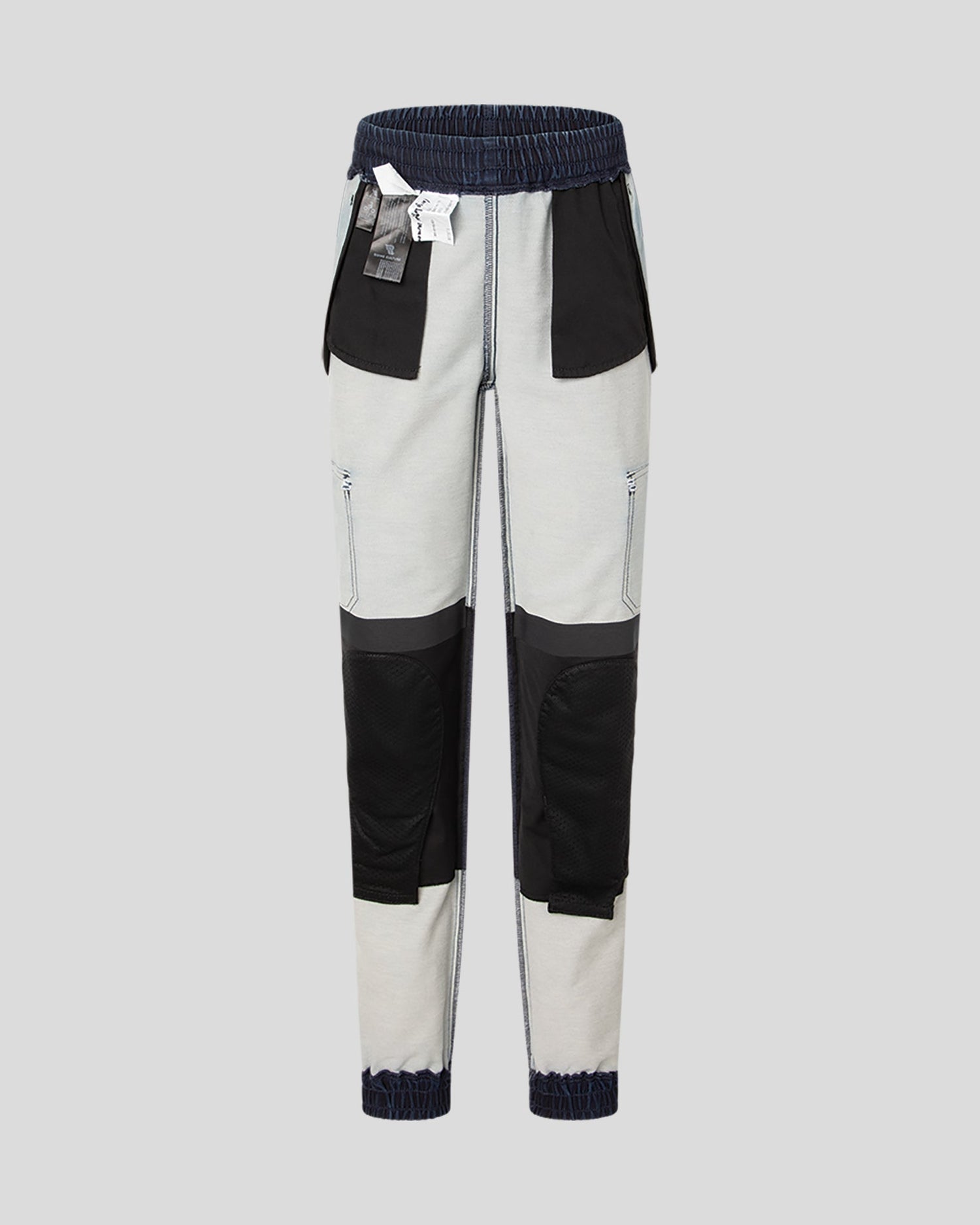
Motorcycle clothing as personal protective equipment (PPE)
Before we turn to the different protection classes for motorcycle clothing, it makes sense to first shed some light on the topic of Personal Protective Equipment (PPE). PPE includes all equipment that a person wears to protect against health hazards at work and was originally created for occupational safety.
Since April 2018, motorcycle clothing has also been subject to the PPE Regulation and must therefore be CE-certified and comply with certain standards.
PPE for motorcyclists is specifically designed to address the risks associated with motorcycling. For example, motorcycle jackets not only offer protection from wind and weather, but are also equipped with special reinforcements and protectors to keep you safe in the event of a fall.
What does CE certification mean?
As a motorcyclist, you’re surely familiar with the small CE logo emblazoned on your protective gear. Just as with electronic devices or sunglasses, CE certification (short for “Conformité Européenne,” meaning “European Conformity”) basically indicates that a product is compliant—that is, it meets the applicable requirements of the relevant European standard.
The Role of CE Certification in Motorcyclist Safety
CE certification plays a key role in protecting motorcyclists. It ensures that the gear you wear has been thoroughly tested and meets the strict health, safety, and environmental protection laws within the European Economic Area.
It should therefore be understood as a kind of confirmation from the manufacturer that the product bearing the CE mark complies with applicable EU directives.
The close connection between CE standards and personal protective equipment (PPE)
The world of motorcycle apparel is, in fact, closely linked to the concepts of CE standards and personal protective equipment (PPE). Thus, motorcycle apparel—such as jackets, pants, gloves, boots, and protectors—falls under the category of PPE.
These items of equipment themselves are subject to specific regulations, classifications, groups, and subcategories that define their use and safety in minute detail. The regulations for PPE in the realm of recreational clothing—particularly for motorcyclists—are governed by the now-harmonized European Standard-EN 17092. While this may sound quite complex at first, it ultimately serves a clear purpose: the rider’s safety.
So what exactly does the European standard EN 17092 entail?
As mentioned in the previous section, compliance with strict norms and standards is at the heart of PPE, ensuring it receives the CE “seal of approval.” For motorcycle apparel, this is the EN 17092 standard, which defines the various protection classes that must meet different requirements. However, it took several decades for this standard to come into effect in the truest sense of the word. It’s important to understand that the development and implementation of safety standards for motorcycle apparel is a complex process deeply rooted in the history of PPE.
Originally, anything classified as PPE had to comply with the so-called Directive 89/686/EEC, which came into full effect on June 30, 1994. Although this directive established detailed requirements, its vague wording left too much room for interpretation.
This led to the introduction of the then-current EN 13595 standard, a standard specifically designed for professional motorcyclists that provided the industry with clear guidelines for impact abrasion resistance, burst resistance, and cut resistance in the event of a crash. Although this standard provided a framework for certification, it was often ignored in practice because it did not cover all aspects of recreational motorcycling.
It was not until the introduction of EN 17092 that a turning point was reached in the history of motorcycle clothing as PPE. After years of discussions and consultations by a working group consisting of manufacturers, testing laboratories, and other stakeholders, a detailed catalog of standards was created.
The decisive breakthrough came with the realization that only clearly defined protection classes allow riders to choose their own clothing based on specific risks and their individual riding style—from high-speed riding to everyday city commuting.
But what does this standard mean for you as a rider?
It’s simple: When you buy motorcycle gear that complies with EN 17092, you can be sure it has been thoroughly tested and will offer you the best possible protection in an emergency. Above all, it lets you see the differences between various garments at a glance,
so that, as a rider, you can choose your gear with confidence in its quality and safety.
Testing Procedures and Protection Classes for Motorcycle Gear
Protection classes for motorcycle clothing – at first glance, that sounds pretty technical. Put simply, protection classes are categorized standards that determine how well your clothing can protect you in the event of a fall. After all, it’s probably happened to all of us at some point: one moment you’re not paying attention, and before you know it, you’re lying on the road. While that might end relatively gently during a leisurely cruise, at higher speeds, an accident without the proper protective gear can turn out quite differently.
What specific aspects are taken into account during the tests?
EN 17092, similar to its predecessor EN 13595, defines specific criteria for the CE certification of motorcycle clothing. This standard specifies in detail which tests must be conducted under which conditions, but leaves open the rationale for selecting certain test elements.
Here’s a look at some key tests that are crucial for your safety:
Tear resistance:
The tear resistance of your clothing is crucial to how well you’re protected, for example, if you were to slide out on a curve. This test measures how much force is required to tear a material that has already been torn. The higher the value, the better the protection.
Abrasion Resistance:
Abrasion resistance measures how well motorcycle clothing withstands a fall onto asphalt. This test, conducted using an Advanced Abrasion Resistance Tester (AART),
checks whether the fabric is resistant to impact abrasion. A material that develops holes larger than 5 mm during this test is considered to have failed. This process ensures that the clothing protects the skin in an emergency. High-quality motorcycle clothing should therefore withstand abrasion without the material being worn through.
Seam Strength:
Seam strength is essential, as it holds critical parts of your motorcycle gear together. The test used for this purpose specifically examines durability by measuring the maximum tensile force that seams in high-stress areas—such as between the sleeves and the body—must withstand to ensure protection in the event of a fall.
Dimensional Stability:
High-quality motorcycle clothing must retain its shape and precise fit even after repeated washings to ensure the protectors remain in the correct position. In the tests, the clothing is washed five times in special washing machines, with parameters such as temperature, spin speed, and water volume strictly controlled. The clothing must not shrink by more than five percent to pass the test.
AAA to C—what do these protection classes mean for motorcycle clothing?
The protection classes for motorcycle clothing—which are classified according to the previously mentioned EN 17092 standard and, in the best case, have undergone all the tests mentioned—provide insight into how well the material and workmanship protect you from potential injuries.
Each protection class is designed to protect the wearer from the specific risks associated with motorcycling, which is why they are also tailored to specific riding conditions and styles.
Below is a brief overview of the five protection classes to help you choose the right gear for your needs.
The five protection classes:
Class AAA – EN 17092-2:2020 (at least 120 km/h*):
Highest protection class—extremely robust and protective
- ideal for: high-speed driving or even professional racing
- Designed for the most demanding and dangerous riding conditions.
- Passes tests with high abrasion standards and offers maximum impact protection.
- Riding Culture jackets and jeans are industry leaders, combining safety with stylish design.
AAA-rated protective clothing ensures maximum protection against impacts and abrasion by using materials and construction methods that exceed the requirements of AA and A ratings. However, it can present ergonomic and thermal limitations on some rides, typically with one-piece or two-piece suits.
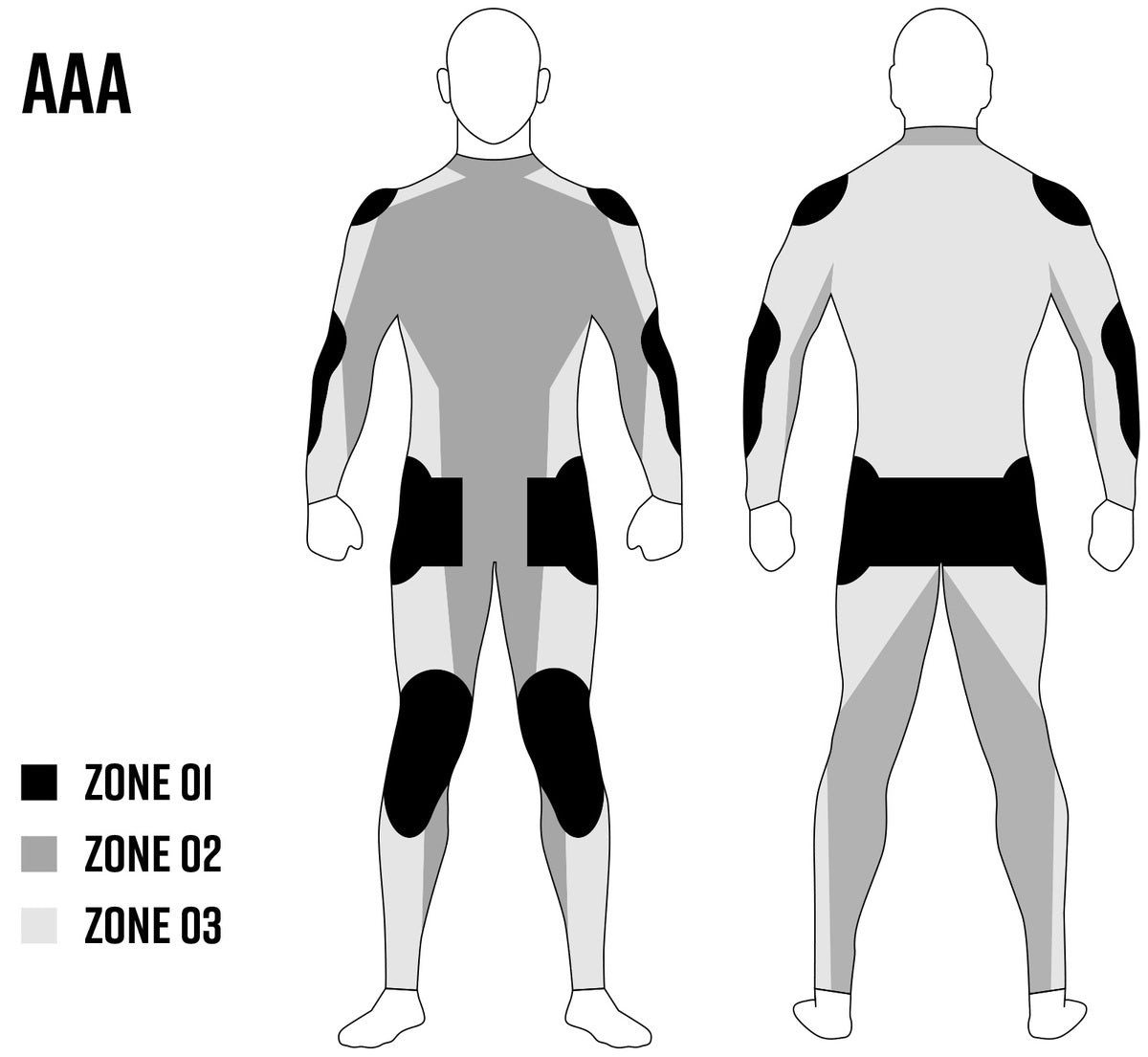
The markings on the graph indicate the ranges of the required tests passed for protection class AAA.
Class AA - EN 17092-3:2020 (70–120 km/h*):
High level of protection—robust, with good impact protection
- Ideal for: Sporty riding on the road, fast cornering.
- Perfect for riders looking for a combination of protection, agility, and excellent comfort.
- Riding Culture also offers a top selection of AA-certified products here, including pantsthat provide protection at speeds approaching the 120 km/h mark.
AA-rated protective clothing protects against impact and abrasion by using materials and construction methods that exceed Class A standards but fall short of the requirements for AAA-rated protection. It offers protection for a variety of motorcycle activities and is characterized by better ergonomics and lower weight compared to the AAA class.
 The markings on the graphic indicate the areas that passed the required tests for Protection Class AA.
Class A - EN 17092-4:2020 (45 km/h*):
Medium level of protection against impact and abrasion
- Ideal for: Everyday riding, touring.
- Characterized by a balance between protection and comfort, suitable for longer rides and a variety of road conditions.
Clothing in protection class AA meets basic protection requirements against impact and abrasion using materials and construction methods that are less stringent than those for classes AAA or AA. This clothing is characterized by optimal ergonomics and comfort and is particularly suitable for warm climates or as a complement to other clothing.
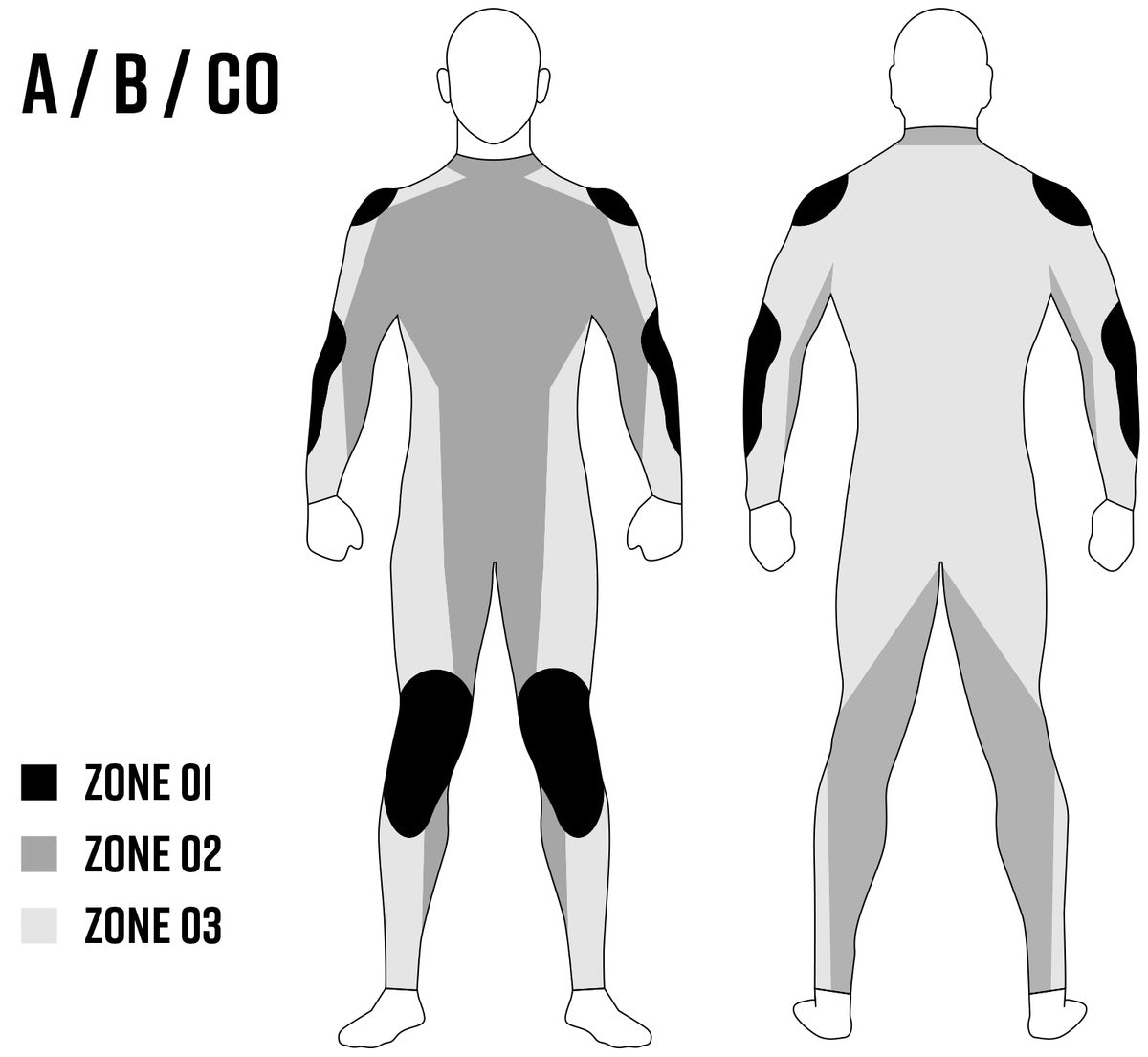 The markings on the graphic indicate the areas that passed the required tests for Protection Class A.
Class B — EN 17092-5:2020 and Class C — EN 17092-6:2020:
For the sake of completeness, it should be noted that Class B motorcycle protective clothing primarily offers light abrasion protection for city riding and occasional riders, but no impact protection, while Class C—usually equipped with impact protectors—is dedicated solely to impact protection.
*These are theoretical laboratory values!
Motorcycle gloves, boots, and shoes are subject to specific standards: EN 13594:2015 for gloves and EN 13634:2017 for shoes. These standards are therefore also crucial for the CE certification of these products.
The guarantee of the highest level of safety: AAA motorcycle protective gear
As you’ve now learned, AAA-certified motorcycle protective gear is the ultimate in protection. This class offers the highest level of protection available and is ideal for you if you like to ride a bit faster or go on long tours and simply don’t want to compromise.
By the way, our premium brand ROKKER has managed to design jeans and jackets that not only meet these top safety standards but are also so comfortable that you’ll almost forget you’re wearing high-tech protective gear.
So what does AA mean for bikers when it comes to clothing?
Not every ride requires the highest protection class. For example, AA-rated clothing offers a high level of protection and is particularly suitable for rides where you typically reach speeds between 70 and 120 km/h. Because of this, this protection class is also the optimal choice for riders looking for a balanced mix of safety and comfort. But—and this is a big but—if you want to really open it up on the highway, you’d be better off wearing AAA-rated motorcycle protective gear.
Here, too, we at ROKKER are pioneers in a sense, because all of our AA-certified products are generally rated for speeds close to the 120 km/h limit, which is why you’re well protected even in AA gear when things get a little faster.
Here’s how you can identify CE-certified motorcycle gear by its labels
If you want to be on the safe side and ensure that your motorcycle gear and equipment are CE-certified, there are a few simple clues that will help you quickly identify this.
For example, on your motorcycle jeans, you’ll usually find a sewn-in label on the waistband that contains information such as material and care instructions, as well as important details regarding CE certification.
Look for these clues to identify CE-certified motorcycle gear
Every CE-certified product—whether it’s clothing, gloves, shoes, or protective gear—should have specific permanent markings.
These primarily include:
- The manufacturer’s name or trademark
- such as ROKKER or the ROKKER logo
- The exact product designation
- The number and year of the relevant standard
- B. EN 17092-3:2020 – which specifies that the garment complies with the standard for protective clothing for motorcyclists
- A correct pictogram showing the specific certification information
- the pictogram of a motorcyclist indicating the protection class - e.g., AA
- The CE symbol supplemented by a user information pictogram, usually in the form of a book icon
- Every CE-certified product comes with user information that includes detailed explanations of the CE label, tips on using and caring for your equipment, and other useful information in various languages.
- Information on size and material
Each of these elements on the product label plays an important role. By understanding and correctly interpreting CE labels, you can make an informed decision about equipment that not only meets your safety needs but also perfectly suits your individual riding style.
Comfort or safety—Riding Culture offers you both!
Whether you choose the AA or AAA class—when it comes to motorcycle gear, safety is no afterthought. It’s important that you always feel completely safe on all your rides and that you always adapt your gear to your riding style. In the past, however, safe motorcycle gear was all too often a compromise between style and safety—usually bulky, inflexible, and anything but fashionable. For some riders, this meant that style ultimately took precedence over protection. But those days are over.
In our products, we consistently combine the protective features of the respective motorcycle clothing safety classes and demonstrate that you can have both—safety and style.
With our unique clothing lines, we stand for trendy and comfortable biker wear, which we always combine with the highest safety standards. Whether it’s casual AAA-certified jeans or stylish AA-rated jackets: choose Riding Culture, because safety isn’t a coincidence—it’s a conscious decision!

Leave a comment
This site is protected by hCaptcha and the hCaptcha Privacy Policy and Terms of Service apply.